Blasphemy!

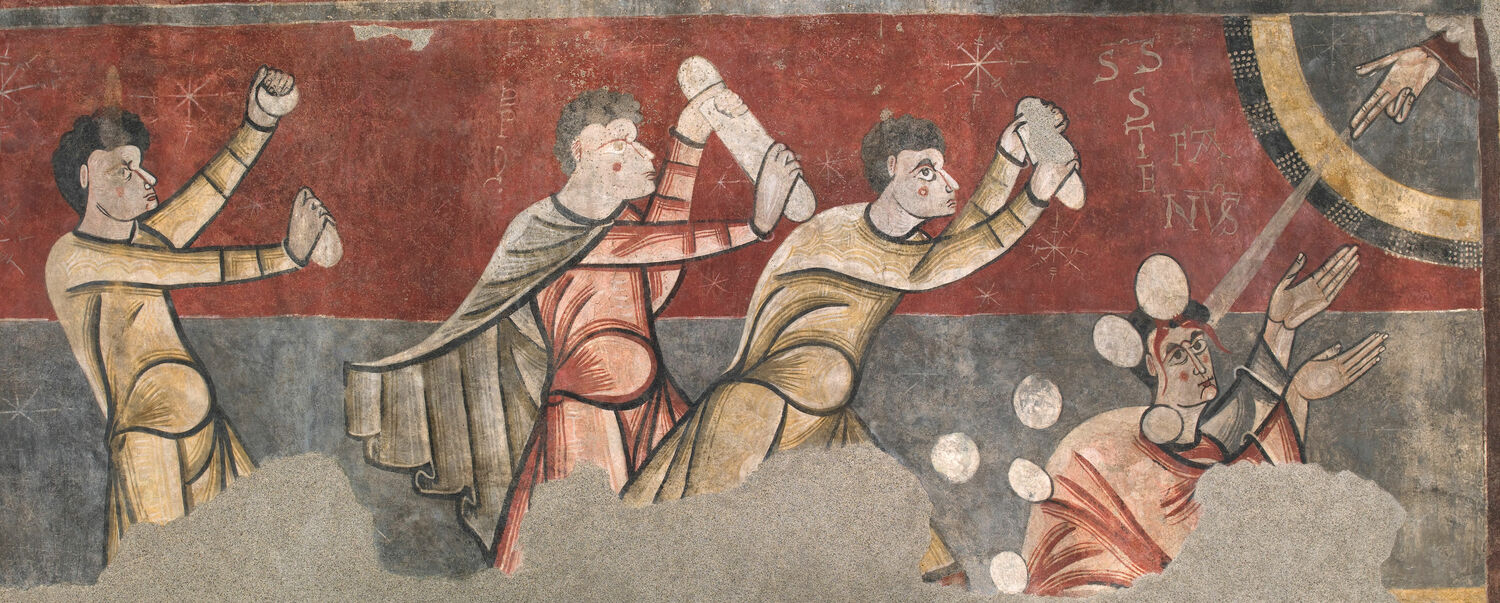
Acts 7:55-60
Easter 5, May 3, 2026
Holy Trinity Cathedral
“Blasphemy!”
The New Testament passage from Acts 7:55-60 says that the disciple Stephen was stoned. Tell that to someone nowadays and they will probably think you are referring to cannabis use. Truth is, Stephen was put to death by lapidation, which is the fancy way of saying that he was judged sinful enough to receive capital punishment. For his faith, he died at the hands of people of faith.
Blasphemy is such an old-fashioned word. Even though it is around us all the time, we don’t stop to think about it much. This is the first sermon I’ve preached on it in my 26 years of ordination! I think it is worth stopping for couple of minutes to consider the ways that humanity takes not just the name of God in vain, but the ways we speak offensively about God. Insults, lack of reverence, even idolatry when someone assumes equality or the place of God. It can be something as obvious as requesting your gym to stop playing music that uses holy names as swear-words. It can be something as devious as a politician taking on the mantle of sanctity without paying anything more than lip service to religion. There are lots of opportunities to debase the name of God, and sadly, most people don’t even do it consciously.
Who is the judge and arbiter of good behaviour and morals? Well, traditionally, it is not an individual but a community. There are often debates- okay, arguments- amongst people of a faith or between faiths. Take the case of Stephen, for example. This disciple of Jesus had stood before the Jewish Council in Jerusalem and rebuked them. He held them accountable for the death of Jesus. In return, they condemned him too. To the Jewish authorities, it seemed as though the Christians were saying that there was another God besides the one who is the God of Israel: the one who had such a sacred name that they couldn’t pronounce it aloud, so they called him Adonai, “Lord”. For the Christians to say that Jesus Christ is Lord was blasphemy. They were violating the ancient Jewish statement of faith called the Shemah: “Hear O Israel, the Lord our God, the Lord is one”. They were also breaking the first commandment: the one that says, “you shall have no other gods before me.” According to the Jewish holiness code, the response of the Jewish Council seemed clear. This was blasphemy. And according to Leviticus chapter 24, the punishment was clear- death.
There was a clear and legal process in the Talmud. The decision required at least 23 Jewish men of good standing and at least 2 witnesses. The condemned was to be pushed from an elevation twice his height and a large stone dropped on his chest. Then, whether he was still alive or not, everyone present threw stones until the sentence was carried out. The community bore responsibility for the decision. Considering human nature, this did not happen very often in New Testament times. Jewish courts usually tried to avoid being held accountable for a death. It was much easier to pass off responsibility to the Roman occupiers. This is what they did with Jesus. But Stephen wouldn’t shut up, and Pilate’s troops were good at looking the other way. So to stop the spreading of what they saw as a lie about this recently executed Jesus of Nazareth, they pronounced the sentence of capital punishment for Stephen.
Maybe we are less aware or more caring, but modern humans tend not to come down so hard on religious differences. Still, there are parts of the world today where stoning is still carried out as a punishment. Blasphemy, idolatry, adultery, homosexuality, and other sexual offences can be judged large enough sins to die this way. It is legal under Sharia law in conservative Islamic countries like Iran, United Arab Emirates, Afghanistan, Sudan, Yemen, and Qatar. In Nigeria and Pakistan sentences have usually been commuted or left unenforced by the justice system. But there are still mob killings by militants, tribal groups, and radicals. Sin is measured against a group’s understanding of God’s holiness and being. If society as a whole do not see God as holy or singular, then the one who blasphemes doesn’t need to fear many consequences. This opens the door to a degradation in our sense of the transcendent.
What does it mean to proclaim now that Jesus Christ is Lord? If we are referencing our creedal statement, that includes our belief that the historical man we know as Jesus was born as the Son of God, lived, died, and rose from the dead, ascended to the divine and is equal to God in power and name. Jesus is God. This is the leap of faith that first Thomas, now Stephen makes. The crux is that Jesus was not just a good man, a teacher, an example, but Godself incarnate and made known to us. This is the trust that Stephen holds to as he dies for his faith. In the scene, he draws so close to Jesus that we hear the echoes of the crucifixion. Stephen prays, “Lord Jesus, receive my spirit” just as Christ cried on the cross “Father, receive my spirit”. And as the killing continues, the disciple kneels and prays, “Lord, do not hold this sin against them” like Jesus forgives those who carried out his death sentence. Even though others condemn, Christ and his followers do not do likewise. Trust and forgiveness give Stephen, whose name means ‘crowned’, the martyr’s crown. This is a type of Christian discipleship. We are to trust and hold true to our Lord in the midst of the sins of the world. For us Jesus has overcome both sin and death.
Stephen is our example. But there is another witness here. It is almost a footnote in this passage, and we will hear much more about him. It is the young man, Saul. Later to become Paul. That’s St. Paul to you and me. But in the start, he is not a positive or even a neutral character. We don’t know whether he is one of the Jewish authorities that passed sentence on Stephen. This young Pharisee may have participated in the stoning or just held back and guarded the coats. But he doesn’t defend or speak up. In fact, he “approves” the killing in the line following this reading (Acts 8:1). It is a pivotal moment for Saul, and for us as listeners. What will he do next? What will we? How do we honour God in word and action?
It is easy to fall into the sin of being offensive to God. Not just from the words we let slip from our lips. But in the times when we assume that we can pass judgment on others. How many stones have we thrown to hurt others, I wonder? The good news is that God can work on our hearts to bring us into a more right relationship. We can speak and act with respect for our Lord and set examples for others, even those we think are beyond saving. A fun fact: this very same Saul, who we meet today in the Scriptures in Acts chapter 7, goes through a whole paradigm shift in his understanding of Jesus Christ as God. So much so that in chapter 14, he is now the target of a mob stoning himself, and barely escapes with his life. The one who cried “blasphemy” finds God’s forgiveness when he realizes that love reach is larger than he imagined. We are invited to keep God’s name holy and worship God alone, but not to exclude others from God’s plan of salvation. That would be offensive to God! Amen.

About
-
Location