I Can't Do It Alone

Romans 7:15-25a
Pentecost 6, July 5, 2026
Holy Trinity Cathedral
“I Can’t Do It Alone”
When I was a little girl, my parents took me to Disneyland. I don’t remember too much, but one ride still stands out. I believe it was then called “the Tomorrowland raceway”. Kids got to climb into little mechanical convertibles and drive them around a great looping track. I got to use the accelerator and the brake as I wanted, and I pulled on the steering wheel with great glee as my brave parent sat beside me scrunched in the compact passenger seat. Little did I know that what was keeping me on the road was a metal guideway running under the automobile. If it wasn’t there I would probably have careened straight into the flowerbeds on the verge. I thought I was driving all by myself. But I had a little help to keep me going straight.
One of the biggest mistakes we human beings make is thinking that we don’t need any help. Yes, everyone has a conscience: an inner moral compass that shows us what is right and what is wrong. You would think that would be enough for everyone to make good choices. For ourselves, and for others. But we all struggle to do right. Even when we know that a decision is not wholesome for our bodies or minds or spirits, or will hurt those around us, there is something else at work. Our immediate desires are perceived as priorities. Our urges overwhelm our intelligence. Our justifications talk us out of our values. We are like the little boy who throws a tantrum in the store. His father tries to explain the difference between getting what he needs and getting what he wants. “But I needs my wants!” he wails. When in the grip of craving something, it is almost impossible to talk oneself out of giving in and taking it. If I think I am strong enough all by myself to resist temptation, I am doomed to fail. I either set myself up for repeated harm, or live deeper into a lie that denies and covers up what I am doing. I become trapped in despair that nothing can change.
If I see myself as beyond hope and help, I cannot reach out. There is a kind of sad spiritual arrogance in believing that nobody could possibly be of assistance. And the truth is, most human systems cannot solve our inner conflict. The law condemns our wrong choices and holds us to account. But it. doesn’t make it any easier to choose differently. Counselling may be helpful in understanding why we do the things we do, but how do we put our learnings into practice? When those around us who love us offer support and encouragement, it is devastatingly difficult to accept their intervention. Even with all of their goodwill, they cannot supply everything we need to make the changes within. We may want to please them and meet their expectations, but the old ways come back to bite us and we disappoint them again and again. Others can point to the right path, but they cannot walk it for us. The good news is that there is One who will walk it with us.
The apostle Paul knew this struggle of the inner self personally. He bares his soul to his readers in chapter 7 of his Letter to the Romans. Here, he uses the contrast between what he knows is good and what he ends up doing anyway. “For I do not do the good that I want, but the evil I do not want is what I do” (Romans 7:19). It is what he calls the flesh- the sinful desires that are warring against his conscience- that push him off the path he wants to walk. He is a good Jew; he knows the Torah or way of righteousness. But knowledge and determination alone are not enough. Sin has a grip on this leader in the faith, and would overpower him if he thought that his own work was enough to make him alright before God. Importantly, however, he does not see himself as evil or without hope. At his core, he identifies as a beloved and redeemed child of God. It is not what he can or cannot do. It is what God has done through Jesus Christ that can free us from the grip and keep us on track.
In Matthew chapter 11, verses 28 to 30, we hear Jesus’ familiar words, “Come to me, all you that are weary and carrying heavy burdens, and I will give you rest. Take my yoke upon you, and learn from me, for I am gentle and humble in heart, and you will find rest for your souls. For my yoke is easy and my burden is light”. In the death of Jesus on the cross, the chains of sin and death are broken. Humanity is unbound from their power. But we are not left in limbo, without guidance or support. Instead, we are offered a new purpose. We are invited to take on the straight and steadfast way of love as it is walked by Christ. He cannot walk it for us. But he can walk it with us. The image given in the gospel is of a yoke that harnesses us anew.
There are yokes and there are yokes, and I’m not talking about the yellow part of an egg. A yoke is a (usually) wooden beam that is fitted for animals or humans to pull a balanced load. A single yoke can bind a beast to a plough or a cart while the driver walks beside or behind the animal to keep it on a straight path. A double yoke allows two or more to share the burden and multiplies the strength for the task at hand. It also acts to regulate the team so that each partner pulls together in the same direction. Now, there weren’t any aircraft in Jesus’ day, but a modern yoke can be found in planes to control the pitch and direction. They too are an important way of keeping on course. Yokes also carry a significance of judgment and subjugation: to be under a yoke is to be under the authority and control of another. But in this passage, Jesus is offering an invitation. His disciples are joining a way that is fulfilling God’s gracious will. The world doesn’t go away. Our burdens don’t magically disappear. The work of the gospel is challenging. But the affirmation is that Christ shares and gives purpose to our lives.
It is an easy yoke because it is fitted for the good of each human soul. Lance Pape, in the commentary “Feasting on the Word”, asks, “How can Jesus offer rest when he asks so much?...What Jesus offers is not freedom from work, but freedom from onerous labor...The easy yoke means having something to do: a purpose that demands your all and summons forth your best...It means work toward a certain future in which all of God's dreams will finally come true. To accept the yoke of the gentle and humble Lord is to embrace the worthy task that puts the soul at ease.” Life is more than a solitary struggle. It is a community endeavour for the kingdom.
The choice is freely yours and mine to make. Love will not force you into servitude. There is no hand of fate that arranges the events of your life towards a certain decision. Although sin can cause us to stumble and succumb to those things that lead us away from love, it can never have the final word. “For God so loved the world that he sent his only Son, to the end that all that believe in him should not perish but have eternal life” (John 3:16). No matter how helpless we are in the face of temptation, if we believe in the power of divine love, there is redemption.
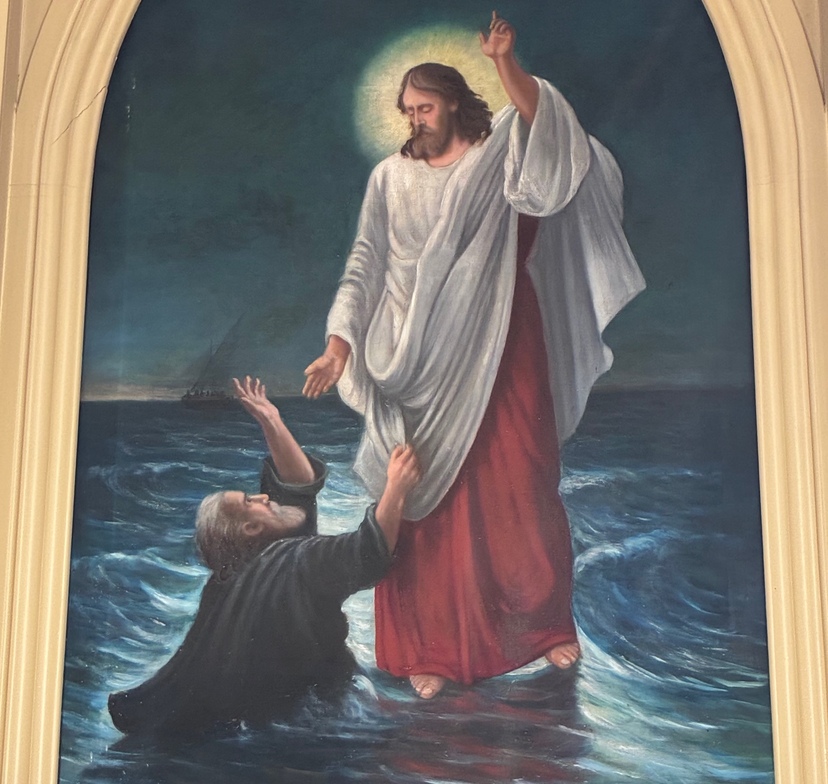
When I was in Northern Norway, I visited a small church dedicated to St. Peter, the patron saint of fishermen. Over the altar was a painting of Jesus walking on the water. Next to him is Peter, sinking into the waves with his arms stretched out to his Lord. Under the painting was written the text in Norwegian, "Lord, help me!". “Lord, help me” is a cry from the soul that will always be answered. In this life and in the next. Amen.

About
-
Location