Made Visible

Matthew 9:9-13 & 18-26
Pentecost 2, June 7, 2026
Holy Trinity Cathedral
“Made Visible”
There are messages that are meant to afflict the comfortable and those that are intended to comfort the afflicted. Jesus’s words to us today are for our comfort. They are directed to all who have had the experience of being invisible, ignored, or discounted.
Within our gospel reading are three separate but connected stories of individuals who receive healing despite their situation. They are all considered impure or sinful in the eyes of the religious leaders. They are all people with whom the righteous do not want to associate. Through their behaviour or their circumstances (and especially for two, gender and age), they are deemed less worthy of attention and help. These are the invisible people that our eyes would slide over and avoid if we could. But the love of Jesus and the words of Matthew’s gospel do not allow us to side-step the question of mercy. The righteous are not those who deserve God’s approval, but those who are made right by Christ.
Who have we here? First, there is a tax collector. We still don’t like tax collection, even when it is regulated by the Canadian Revenue Agency. These days, we need to be alert to scammers who pretend to represent legitimate institutions. Don’t pay your taxes with gift cards or cryptocurrency! Back in Jesus’ time, it was much worse. Being a tax collector was a despised occupation because Jews were contracted by the Roman occupiers to squeeze taxes out of their fellow citizens. Some charged a fair percentage to make a living, but many had a reputation as greedy and unscrupulous, marking up what was owed to the Empire in order to grow rich themselves. Because they dealt with foreign currencies bearing the image of Caesar and answered to the Romans, tax collectors were considered a pretty sinful bunch. You wouldn’t invite them to supper. Yet the man called Matthew is spotted by Jesus and called from his tax booth to become a disciple. Jesus is not afraid to sit at table with him at his house and even entertain his acquaintances. When the religious leaders challenge his honour and authority in associating with sinners, Jesus reminds them of his mission: “I have come to call not the righteous but sinners” (Matthew 9:13). Those who are not deemed by human wisdom as worthy of redemption are the ones God reaches out to save.
The disciples, including Matthew, then get another example of God’s mercy. The second healing is the daughter of one of the leaders of the synagogue. She is not a sinner in the sense of doing something horribly wrong, except that she has died! To ask Jesus to come and lay hands on a corpse is either an astounding act of faith on behalf of the father, or a test of how willing Jesus is to lay himself open to charges of ritual impurity. But Jesus does not ignore the need of the vulnerable girl child or the grieving father. He sees the opportunity and walks with his disciples to the home where the mourners are gathered.
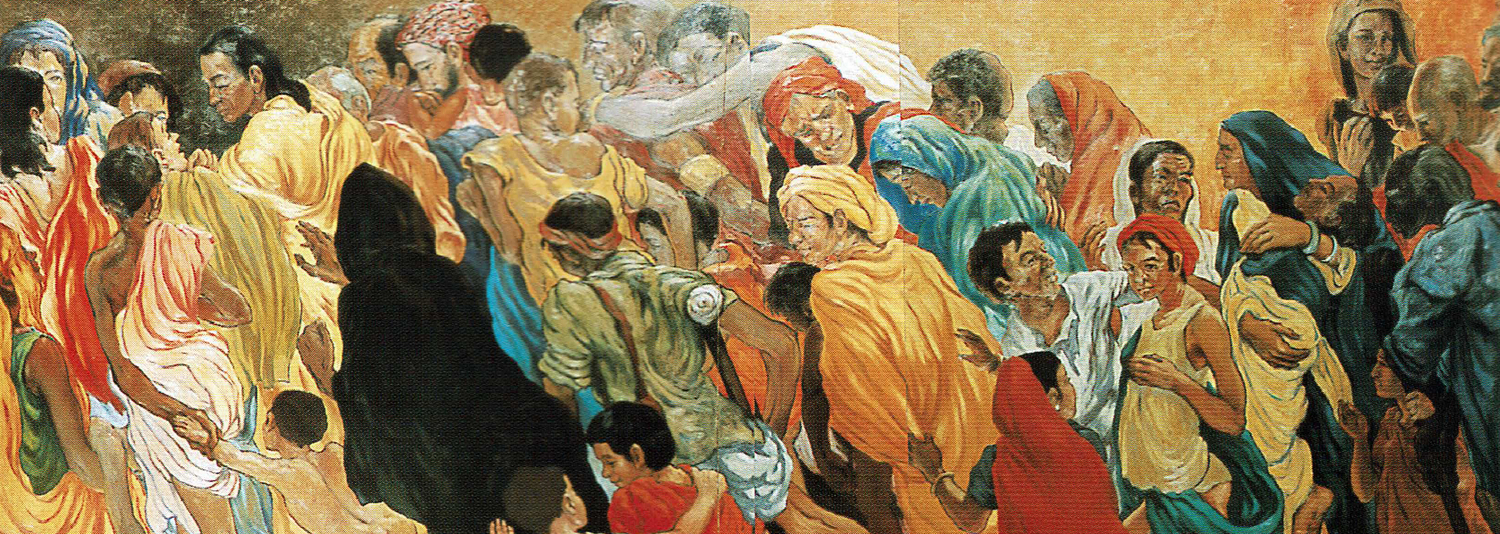
And along the way, the third, and perhaps most shockingly beautiful, healing occurs. A woman who had been bleeding for twelve years, comes behind Jesus and touches the edge of his outer garment. Here is someone who is both invisible and unwanted. Her disease marks her as unclean and sinful- outside of the temple community. The hemorrhaging, or flow of blood, is not detailed, but even the regular monthly cycle of female menstruation was regarded as something that set women apart from the daily life of a community. Females were not to touch certain things or prepare foods, to abstain from intimate relations, sometimes to withdraw from male company entirely. Imagine these taboos extended because of a medical condition that would not have been understood at the time! To be suffering from a gynecological disease that weakens and isolates her further and further. To her credit, she does not want to present herself in public or put Jesus at risk of becoming unclean as well. She finds a creative way to reach out- by only touching his cloak. Yet Jesus recognizes the moment. He turns and gazes on her. The invisible woman in the crowd becomes visible and Jesus pronounces, “Your faith has made you well.” All those present are witnesses that God chooses to heal those who have faith, not favour through works.
Let’s not leave out the healing of the little girl. She too is seen and embraced by our Lord. The mourners disbelieve Jesus when he tells them she is not dead, but his touch does bring new life. Sickness is not caused by sin, and recovery doesn’t depend on works righteousness. Instead, the grace of God is made known to those who had been discounted by the world.
These are important stories to be shared by a faith community that is in the minority, like the churches that the gospel of Matthew was written to encourage. They are reminders that God sees what the world overlooks. The poor, the weak, the struggling, the suffering, are beloved of God. Mercy reaches out to those who are not seen as important or rewarded. Jesus saw the outsider and reached toward them with healing hands. These are important stories to share today. Whenever we feel like we are disregarded, forgotten, or passed over, the call comes: “Follow me”. Whenever we are hurting, grieving, or dead inside, the word invites, “Be made well.” Faith is met by mercy. We are regarded with eyes of love, if we have the courage to lift our own to meet our Lord’s. Amen.

About
-
Location