Recognizing Sheep

Matthew 25:31-46
Reign of Christ, November 22, 2026
Holy Trinity Cathedral
“Recognizing Sheep”
My spouse and I recently had an animated discussion about whether sheep and goats are the same species. ‘They are not’ says I, backed up by genetic evidence and classification. ‘They are too, because they can interbreed’, says he. We are both right. However, Ovis aries with 54 chromosomes and Capra hircus with 60 chromosomes look and act differently. When the two interbreed, the unfortunate results- called geeps or shoats- are not successful experiments. But the parable from Matthew chapter 25 is not to be summarized by simply stating “Sheep good; Goats bad: don’t mix”. The important lesson Jesus is pointing to is that God recognizes members of the flock by what they do.
Jesus uses the familiar (to his first century listeners) to illustrate. Herders often kept mixed flocks in the communal village pens. When they are brought out to feed, sheep and goats are sorted into groups. Even the youngest helper can spot the physical differences between the two. That’s important, because they have different behaviours. Sheep are grazers and must be led to fresh pastures and sources of water. Goats are the lawnmowers of the animal kingdom and should be set loose somewhere away from the community vegetable gardens. It is the job of the shepherd to know who’s who. It is that act of judging rather than the act of separation into categories that Jesus wants us to focus on. Just as a shepherd knows which is a sheep by the way they behave, the King of glory will know the faithful by the way they have lived their lives.
Now sheep are communal animals. They feel safer when they are in a group. And so do we. In Jesus’ parable, he pushes the boundaries of how we treat each other beyond those close to us. The king, in judgment, commends those who helped others in need: the hungry or thirsty, the naked, the sick, the imprisoned, the stranger. “I was a stranger and you welcomed me”, the king declares. Even if the faithful didn’t know the stranger, they recognized that here was someone in need and they responded with compassion and generosity. An alternate reading of this verse is “I was outside and you gathered me in”. The kingdom of heaven is not a closed circle but an ongoing and expanding action in this world. Those who participate in welcoming the stranger are open to recognizing Christ in another.
The prophet Ezekiel criticized the leaders of the historical kingdom of Israel centuries earlier. The problem is that the elite are complicit in sin when they grow prosperous and strong at the expense of the many. The “fat sheep”, like those in the parable who have ignored the needs of those around them, have not followed the true shepherd. They have wandered off-track to fill their own stomachs without caring for the more vulnerable ones they have left behind.
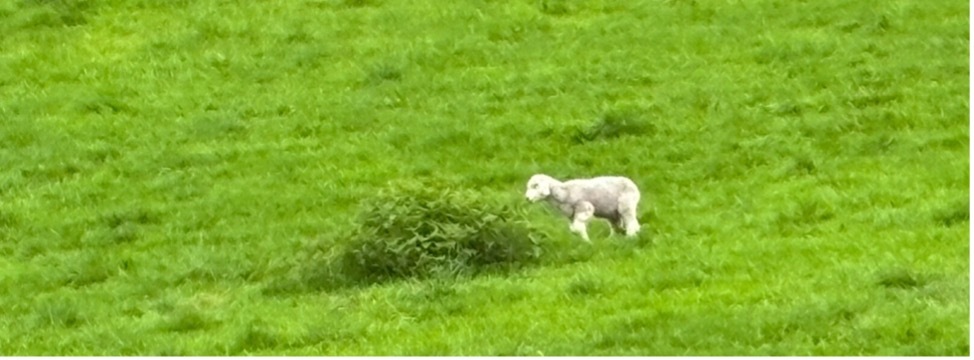
When I was travelling in Norway, we cruised up the longest fjord to the village at the very end. The ship was large and had to moor at a dock some distance away, so we followed the path by the still waters. It was raining hard, and a procession of orange umbrellas proceeded down the track. We passed a large farm on the hillside, with large enclosures for livestock. In one was a single animal. In the downpour it was hard to make out whether it was a lamb or a kid until it let out a plaintive little bleat. Where was its mother? Where was the shepherd? Was it too dim to get out of the rain, or had it been left behind when the rest of the flock was taken into the barn? After our day out, we trudged- very soggy- back to the ship. I was relieved to see that someone had come and gathered it in. We can’t respond to every need. But when we hear a cry for help, do we have the heart to respond or will we ignore it?
We can’t judge what is inside another. Their motivation and their thinking are hidden from our sight. We can only pick up on external signs. What is someone asking of us, through their words perhaps, but also through their behaviour and their appearance? Whether we feel able to respond ourselves or are moved to call on others to assist, we are part of bringing the kingdom nearer. When we turn away, justifying that it is someone else’s problem or denying the need, we also push the kingdom away from our reach. Writer Francis Clark comments, “to feel sorry for the needy is not the mark of a Christian. To help them is.” It is right to pray for the kingdom to come with all our being. The next step is discovering opportunities to make it so.
The Reign of Christ will come fully at the end of the age. But it is already active. The blessing of inheriting the kingdom prepared before the foundation of the world comes in glimmers to our daily lives. You can recognize the followers of the Shepherd by how they listen to His voice and act in kindness, justice, and mercy. Good sheep make room for the stranger, and see a brother or sister gathered in.
A poem by Ann Weems:
He said, ‘feed my sheep’.
There were no conditions;
Least of all, feed my sheep if they deserve it,
Feed my sheep if you feel like it.
Feed my sheep if you have any leftovers,
Feed my sheep if the mood strikes you.
If the economy’s OK…
If you’re not too busy…
No conditions… just, ‘feed my sheep’.
Could it be that God’s kingdom will come
When each lamb is fed?
We who have agreed to keep covenant
Are called to feed sheep
Even when it means the grazing will be done
On our own front lawns.

About
-
Location