Beyond the Map

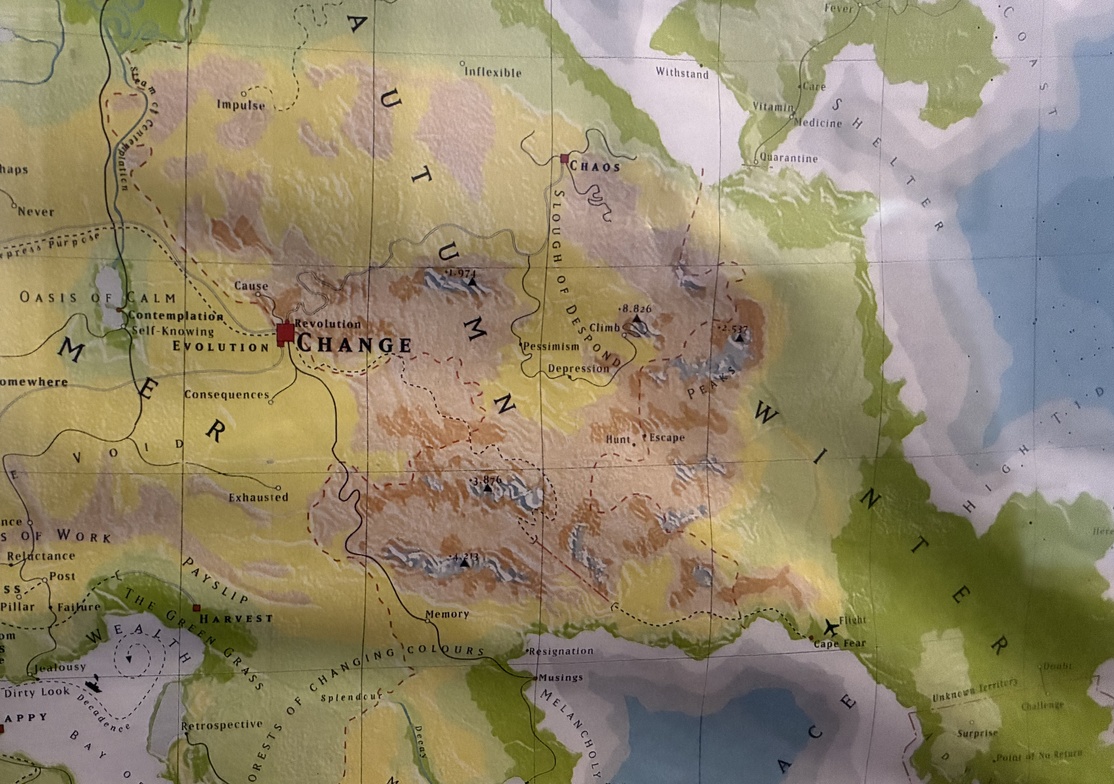
Deuteronomy 34:1-12
Pentecost 22, October 25, 2026
Holy Trinity Cathedral
“Beyond the Map”
Today marks the ending and the beginning of a story. In our Hebrew Scriptures and in our own lives. It’s a good reminder that although maps aren’t always right, we can look for direction from above. For those who feel a little lost and bewildered right now, we turn to our faith for illumination. As the psalmist says, “Your word is a light to my feet and lamp for my path” (Psalm 119:110). What can we learn from the people who have gone before us?
My husband and I were travelling through California to visit my eldest aunt outside of San Francisco. He was driving and I was navigating with the help of a BCAA roadmap of the state. We successfully navigated our way through the heart of the city and began keeping an eye out for the exit. (It was during this trip that we learned American freeways have ramps to both the left and the right, and it was important to tell your pilot which one was needed in advance. The response to the question ‘this exit?’ needed to be ‘correct’, with an indication of ‘go right’ or ‘go left’. Just saying ‘right’ got us into trouble more than once.). We recognized the road signs and began to negotiate our way in the right outer lane in preparation for leaving the highway when a huge sign loomed up: Exit closed due to earthquake damage! The next hour was spent backtracking through a sketchy run-down section of San José before we could retrace our route.
Even with the advent of Google maps or Apple maps, we still manage to get lost going from A to B, don’t we? Whether it is due to traffic accidents, road work, or not leaving enough time to negotiate a turn, we are still prey to that insistent AI voice that tells us that it is ‘recalculating’ our route. The guidance we get is only as good as the input into the app and our ability to understand it and respond. So much depends on others. Who here hasn’t checked how long it will take to get to a destination only to find that surprises enroute add much more time to the journey?
The Hebrews escaping from slavery in Egypt weren’t told their estimated arrival time in the Promised Land. If anyone had said, “forty years in the wilderness” I wonder how many would have chosen to stay behind? The old joke is that it took that long because Moses refused to ask for directions, in spite of his wife’s advice. Oral history may have recorded the geography, but there were few guides and fewer maps of the area. Time after time circumstances forced the company into new and unknown paths. There is no straight road between Egypt and Israel. A whole generation lived into the wilderness experience. At the end of forty years there were few elders who had left captivity. Most of the people had died in transit without even setting eyes on the home they had been promised. The books of Exodus, Leviticus, Numbers and Deuteronomy contains the stories of mistakes and learnings, consequences and forgiveness, laws and mercy. They tell of a nomadic people being reformed to trust in God despite their struggles.
And now, Moses is standing at the heights of Pisgah, on the edge of the Promised Land. He is perhaps the eldest of them all, the last of his generation. He gazes down at what will be the future for his people. His eyes search out the towns and lands that will be part of the new story. But he doesn’t get to go with them, to cross the Jordan. He dies short of completing his task of shepherding the people. That mantle will pass to Joshua. The prophet and lawgiver that knew God face to face ends his life in the wilderness. Rabbinic commentary says that the angels were too afraid of Moses to bring him to heaven. Instead, it is God who descends to earth to claim his servant’s soul with a holy kiss. He returns to his Creator who had promised him that I AM will be with you always.
Wisely, the people mourn Moses before moving on. He is buried in an unknown grave. Hidden, so that it will not be a shrine to tie the Israelites to that place and time. They do not hurry; they mourn their leader for thirty days. They raise up Joshua as a new leader, full of the spirit of wisdom. And then, they are ready for the next step. To start a new book of the story.
We have all of us experienced the longing for completion while living through a “not yet” time. Things take a lot longer than the plan that we mapped out on paper or that we imagined with those close to us. Life has a way of happening and complicating the journey. Just when we seem to be getting our balance, a new challenge is thrown our way. Back into a wilderness we go: to seek more information, to ask further advice, to figure out a plan B when plan A gets booted sideways.
Look at the property development project here at Holy Trinity Cathedral. We’ve only been at it for twenty years so far! (Please God, may it not take forty). In that time, there have been more twists and turns of the plot than we thought possible to cope with. Wise leaders and elders have given time and experience to each phase of the work. Some have died without seeing the end results. And yet, that same God who promised to be with Moses every step of his life promises to be with us too. God invites our trust to continue. We can gather resources and allies towards the goal, but the important reminder is to direct our gaze upwards as well as outwards.
Joyce Rupp has written a poem called “Old Maps no Longer Work” that describes what is needed.
I keep pulling it out –
the old map of my inner path
I squint closely at it,
trying to see some hidden road
that maybe I’ve missed,
but there’s nothing there now
except some well-travelled paths.
they have seen my footsteps often,
held my laughter, caught my tears.
I keep going over the old map
but now the roads lead nowhere,
a meaningless wilderness
where life is dull and futile.
“toss away the old map,” she says
“you must be kidding!” I reply.
she looks at me with Sarah eyes
and repeats “toss it away.
It’s of no use where you’re going.”
“I have to have a map!” I cry,
“even if it takes me nowhere.
I can’t be without direction,”
“but you are without direction,”
she says, “so why not let go, be free?”
so there I am – tossing away the old map,
sadly fearfully, putting it behind me.
“whatever will I do?” wails my security
“trust me” says my midlife soul.
no map, no specific directions,
no “this way ahead” or “take a left”.
how will l know where to go?
how will I find my way? no map!
but then my midlife soul whispers
“there was a time before maps
when pilgrims travelled by the stars.”
It is time for the pilgrim in me
to travel in the dark,
to learn to read the stars
that shine in my soul.
I will walk deeper
into the dark of my night.
I will wait for the stars.
trust their guidance.
and let their light be enough for me.
May we look to God as the perfecter of our faith to show us enough light for the next step. Amen.

About
-
Location