Meeting the Light in Joseph

Matthew 1:18-25
Advent 4, December 21, 2025
Holy Trinity Cathedral
“Meeting the Light in Joseph”
In the last few weeks, we have been exploring how God’s light shines through some individuals who are named in the birth narrative of Jesus. Matthew’s gospel was our starting point for looking at the role of the gospel writer. Then John the Baptist and Jesus’ mother Mary were introduced through our Scriptures. Today we look to meet the light in Joseph. But first we have to find him.
Joseph is not the most well-known or popular saint for Anglicans. Do you know how many churches across Canada are named for him? One: St. Joseph of Nazareth Anglican Church Brampton, Ontario. Roman Catholics are more generous in their favour. There are twenty-eight parishes and five cathedrals that bear his name in our country alone. Beyond our borders, numerous San José’s, Santo Guiseppi’s, Sancto Josephus’, and Qadi Yusef’s abound. Seems there is something we have missed here. Perhaps it is time to better appreciate the man who was the human foster father of the Son of God.
Joseph’s actions speak louder than his words. In fact, he doesn’t get any sound bites. His role in the Scriptures is a walk-on part. He is a supporting actor rather than a leading man, in the shadow of the beloved virgin Mary. Make no mistake, however! The choices of this man are crucial to the gospel story. Because Joseph follows the intent rather than the letter of God’s holy Law, he sets up the coming of the Kingdom of heaven. He was not a disciple of our Lord. He doesn’t live to be a witness at Jesus’ death and resurrection. In this sense he belongs with the “Old Testament” saints. But because of his lineage and his faithfulness, Joseph is the vital link between the Hebrew Covenant and the New Testament in Christ.
The way that the gospel of Matthew jumps into the story of the good news is evidence of this. Matthew chapter 1 begins with a genealogy. The whole recitation, of tracing back “Jesus the Messiah, the son of David, the son of Abraham”, is to legitimize the claim that Jesus is the anointed Saviour of Israel. And it all comes down through Joseph’s side of the family. The list tidies the generations up a bit- emphasizing important ancestors but also how God used flawed people and foreign/gentile wives to further the divine plan. All the way from Abraham to David, and from David to Joseph’s son, the family tree lays out why Joseph’s line is so important. Jesus is rightly called “David’s son” and the “Messiah” for Israel.
But there is a second reason why Joseph ought to be revered. His acknowledgement of Jesus as his son gave this child protection and a place in his society. It is clear that Joseph is not Jesus’ biological father. Mary states firmly that she has known no man, that is, she is a virgin. She is “found to be with child from the Holy Spirit” (Matthew 1:18). The gospel of Matthew adds that Joseph did not have marital relations with her before the birth of her first child. In first century Israel, these present issues for both a mother and a child. The child has no status unless he is acknowledged. Having a legal father was more important than whether he got daddy’s nose or earlobes. For both Jews and Romans, the abba or pater extended protection, rights, and status over the household. By accepting Mary as his wife, including the child she carried, Joseph accepts Jesus as his own. This he demonstrates in naming the child and raising him within his home. The world therefore knew and accepted Jesus as “the carpenter’s son”.
This was not Joseph’s original thought. When he finds out that Mary is pregnant, and not by him, he has a choice. As a good Jew, he could claim the law of Deuteronomy and break the engagement. The result of this would be to expose Mary as a sinful woman- whether by adultery or rape (apparently a woman who did not cry for help loudly enough when assaulted was seen as guilty). If Joseph did go this route, Mary might get off with the disgrace of being soiled goods. Or she might be taken out of the town and stoned to death. More appealing to his kindly nature was the prospect of a quiet future divorce. Only men had the power to determine either course of action, while women bore the brunt of shame, economic loss, or loss of their lives. God sends a messenger to Joseph to propose alternate plan C: take Mary as his wife and do not be afraid of what will come next.
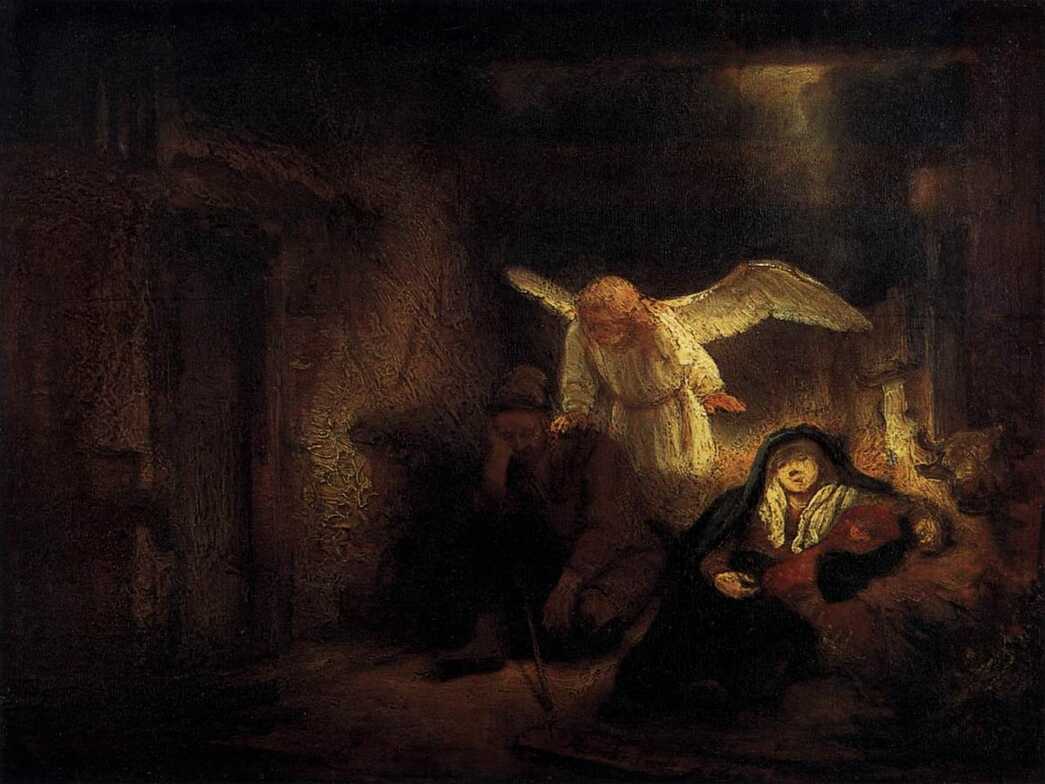
Joseph meets an angel while asleep several times in the next couple of years. Like the Old Testament Joseph from Genesis, he is a dreamer. And like his distant namesake, he listens and responds with faithful action. In a painting by Rembrandt, the slumbering figure is bathed in light as the angel visits. Joseph sees the light and follows the right path rather than the easy path. That same angel visitor will return to him again after Jesus’ birth to warn of King Herod’s murderous intent for the babes of Bethlehem. Joseph then suddenly uproots his new family and flees to Egypt. He waits there until the next annunciation that Herod is finally dead and he can return to Israel. A fourth dream update diverts the homecoming and sees the family establish in Nazareth, where Jesus spends his childhood. Throughout this tumultuous time, Joseph puts the safety of his household over his own security and livelihood. It’s a good thing carpentry is a portable skill, for he continues to provide for his wife and son as the family grows.
We don’t know much more about Joseph’s role in Jesus’ subsequent life. There were brothers and sisters, who may have been younger siblings or perhaps Joseph’s children by a previous marriage. Joseph very probably died before Jesus reached adulthood. A clue is the absence of appearances in Jesus’ life after that episode at age twelve when he slips his parents’ watch and stays behind in the temple at Jerusalem. Another is the record that during the crucifixion, the dying Jesus makes one of his disciples promise to look after his mother. He would not have entrusted her into another’s care if Joseph was still alive. The sense we get by reading between the lines is of a caring, loving, deeply faithful foster father who regarded Jesus as his responsibility. Once Joseph made his choice, he didn’t look back. Instead, he placed his confidence in God’s word that this boy would be Emmanuel, or “God-with-us”. The name he gives the child proclaims his faith. Jesus, or Yeshua, means “God saves”.
Joseph was prepared to do his part even though he would not live to see the result. But as his son goes on to say in his public ministry, “God is not God of the dead but of the living”. He is the God of Abraham, Isaac, and Jacob. And of Joseph too, who is part of the resurrection. He may not have as much to say as the prophets or some of Jesus’ apostles. But by recognizing his role, we come to meet God’s light. Spare a moment to give thanks for all the saints out there who don’t have a church named after them or stories written of their exploits. Those who work tirelessly in the background to support and protect the vulnerable, those whose livelihood feeds and shelters their households, and those whose faith steadily guides them to compassionate action: these are God’s servants. Because they meet the light, we see the light through them. We can do the same. Thanks be to God. Amen.

About
-
Location