Meeting the Light in Mary

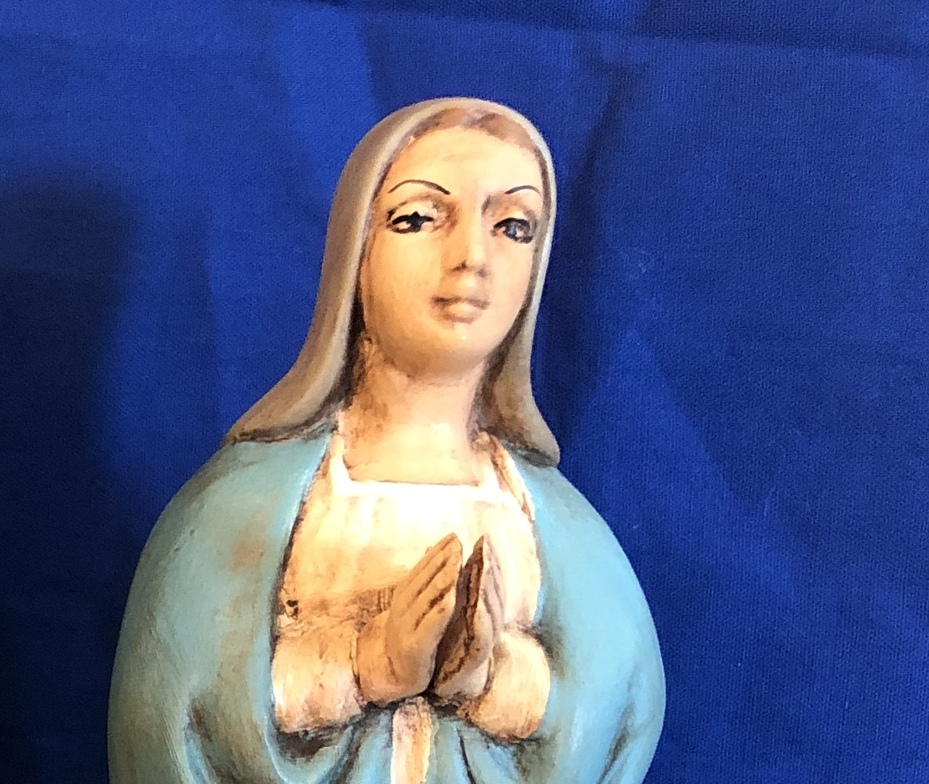
Luke 1:46-55
Advent 3, December 14, 2025
Holy Trinity Cathedral
“Seeing the Light in Mary”
In the Christian Church, Mary the mother of Jesus is highly revered. You probably recognize some of the words of this prayer, even if you haven’t used it yourself:
“Hail, Mary, full of grace.
Blessed art thou amongst women and blessed is the fruit of thy womb, Jesus.
Holy Mary, Mother of God, pray for us sinners, now and at the hour of our death.”
People of faith turn to Mary as both an example of discipleship and a saint who is helpful in their own life struggles. Anglicans do not, as is the practice of some Roman Catholics, ask Mary to intercede on behalf of her son with our prayer requests. However we do see her as a human whom the Light shines through brightly because of what God has done in her.
Mary was an ordinary girl living in first century Israel. She wasn’t rich; she wasn’t important; she wasn’t perfect. She was betrothed to be married, but she wasn’t yet in an intimate sexual relationship. A messenger from God comes to her and tells her,
“Do not be afraid, Mary, for you have found favour with God. And now you will conceive in your womb and bear a son and you will name him Jesus. He will be great and will be called the Son of the Most High” (Luke 1:30).
She is not afraid, but she is troubled by how this can be. She declares ‘I am a virgin!’ The Greek literally says, ‘I have not known a man’. We understand the mechanics. Even this girl barely out of childhood knows where babies come from. It takes two to make a third. This will be a problem for Mary, her community, and all subsequent believers as we try to understand the work of the Holy Spirit in this quickening in the womb. As impossible as it seems to accept that God becomes incarnate in a human form, everything is possible with God. From ordinary, Mary becomes extra-ordinary.
Humans tend to look for the ‘how’ through science or doctrine. Some said that Jesus was Joseph’s boy. After all, he and Mary were betrothed to be married. A premature child wasn’t too uncommon. Some have wondered whether Mary might have been forced by another man, perhaps a soldier or stranger. What human agency has begun is then perhaps rescued and sanctified by God. On the other end, theological ideas have been put forward to cleanse not only the role of an asexual Holy Spirit but to make Mary without sin from her birth as well. The Roman doctrine of the immaculate conception refers not to Jesus but to his mother. The vessel, the thinking goes, must be pure enough for the contents, so Mary had to be the perfect woman in order for her to be the bearer of the Lord. But these explanations do not allow for Mary’s ‘Yes’.
Jesus was born into a sinful, broken world through an entirely human mother who was part of that creation. God choosing her to upend and save the world was dependent on one thing: Mary’s free choice. Love cannot be forced. And the Light coming into the world had to be accepted and carried in the body of one who was willing to be changed. The plan to upend the world starts with the individual. Mary was poor, humble, unmarried, and confused. She became magnificent, exalted, and faithful as the mother of our Lord. She opened up the path for the Light to shine through to all.
Last week we heard the proclaim of John the Baptist in prophesying Jesus as the Messiah, the anointed One of Israel. But long before that, when John was still a baby in the womb, it is his mother who foretells that Mary will be great among women. When her cousin comes to visit, Elizabeth greets Mary with the words that will form the basis of the Hail Mary prayer. “And why has it happened to me that the mother of my Lord comes to me?” John appears to agree by kicking her in the belly! The confirmation of God’s action in her pregnancy comes not through the angel Gabriel, but by Mary’s even more pregnant cousin. And it is in this encounter that Mary bursts into the song we know as the Magnificat. This is a manifesto! The words, similar and perhaps modelled on Hannah’s song in the Hebrew Scriptures, declares that God is turning the world right-side up.
Here is a girl poised on the edge of womanhood, facing her fear and anxiety about the changes happening to her by singing out her faith. Have you been pregnant? It’s a time of constant change. Mary’s body is changing: breasts becoming sore and heavy, stomach growing taut, complexion glowing, appetite uncertain, new aches and tiredness and nausea and moods. This is unknown territory. And her relationships are changing too: with her parents, Joseph, the people of her village, religious leaders. But as she ponders what God is doing, she finds resilience and patience and persistence. This is not passive waiting for something to be “done” inside her. Mary is actively cooperating with the Divine power. Christ is able to grow inside her because she is changing too. The baby within draws on both her human nurture and the Spirit’s sustenance. Somehow, this turning is towards the good. For Mary, for the child she carries, and for all.
The words of the Magnificat are joyfully subversive. Mary recognizes that what God is intending is not what the rich and the powerful want. The lowly will be lifted up. The hungry will be fed. The people will be helped because of the promise that God maintains in his covenant of love. And somehow, she is part of this, because she has the courage to say ‘Yes’.
The challenge for the Church is not to portray Mary as a plaster saint, smiling meekly and modestly beside the manger. The incarnation, the ‘enfleshing’ of God, is only possible because of her. Not because she was particularly holy. Not because she happened to be in the right place at the right time. But because she answered the call with “here am I, the servant of the Lord. Let it be with me according to your word” (Luke 1:38). From then on, she partnered with God in the changes. This is why the light shines through her.
It is why the light can shine through any one of us as well. We are not particularly holy. We don’t have to be in the right place at the right time. Faith is not a matter of passively waiting for God to come and fix the world. Each of us is part of God’s plan to be incarnate, to be God-among-us. To meet the light with joy is to allow the Holy Spirit to be kindled and carried within. We become pregnant with possibilities when we allow God to dwell in us. Each of us can bring something new to birth, according to God’s word. It may be a child. Or a book. Or a painting. Or an organization. Or a treatment. Let your imagination go wild! After all, nothing will be impossible with God if we say ‘Yes’. Amen.

About
-
Location