Good Guys/Bad Guys

Exodus 14:19-31
Pentecost 16, September 13, 2026
Holy Trinity Cathedral
“Good Guys/Bad Guys”
In the old movies, you could tell the difference between the good guys and the bad guys by looking at them. The sheriff or the noble gunslinger wore a white cowboy hat; the evil villain wore a black hat. The rebels may have dressed in camo, but Princess Leia wore white. And the stormtroopers wore white armor, they were controlled by Darth Vader, fashionably attired in a black cape and mask. We like seeing the world in contrasting terms. It is easier to choose a “right” side and to see the other side as wrong. Actions get justified. Moral high ground is claimed. God is with us. And when we tell the story, we try to look better so the other ends up deserving punishment, not forgiveness.
Except the world isn’t black and white. It never has been. God works with those who are paying more attention, even if they aren’t rich or powerful or smart. They are not better than others. They are not more deserving. But if they listen and follow, there’s a chance that they will encounter a God who is loving and forgiving and generous in mercy. Once we understand we are not always right, it is easier to make room for the idea of forgiving others. If God has mercy on us, ought we not to do the same with those around us?
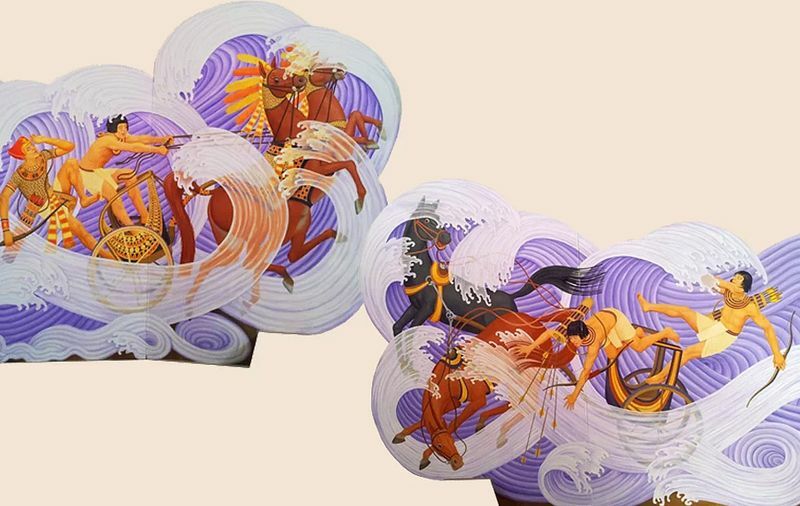
In the Exodus story, the Pharoah of Egypt is painted as the bad guy. He wouldn’t grant freedom to the Israelite slaves even after the God of the Hebrews sent plague after plague as signs of power. After his son, and the other firstborn of the Egyptians, died during the Passover of the angel of the Lord, Pharoah finally let the people go. Then he changed his mind and ordered his army to chase them down at the Red Sea. A miraculous intervention allows the Israelites to pass between the waters ahead of the army, and then the waters close again over the Egyptians. The bad guys are defeated, the good guys win, and much celebration ensues on the Israelite end.
That’s the way the story is usually told. It is written from the point of the followers of the God of Abraham and Israel. First: God is the God of the Chosen People. And second: God is the God of all peoples. That includes both the Hebrews and the Egyptians. Those who listened to God through Moses and Aaron and Miriam were brought out into the wilderness through God’s mercy and grace. Those who didn’t listen bore the consequences in Egypt and on the shores of the Red Sea. But they were God’s children too. In rabbinic commentary, God is portrayed as weeping at their destruction.
There are signs within the text that God is trying to keep the two sides from coming into direct conflict. During the night before the great parting of the seas, there is a holy cloud that divides the Israelites from the Egyptian army. They are kept apart so as not to come into open fighting. And when the Hebrews start down the path between the waters, the Egyptians are kept from overtaking them by the wheels of their chariots clogging in the mud. At this point, the soldiers recognizes that the Lord is fighting for the Israelites. They want to flee back the way they came. Their leaders are slow to sound a retreat, however, and they are overwhelmed by the returning flood.
One lesson that the Israelites were to carry with them from their experiences is that they were not special because they were good, or because they were deserving, or because they were right. It is simply because they belong to God. They were invited into a special relationship and are expected to carry that out in their covenant by living according to righteousness. God saved them from slavery and starvation and homelessness. God gave them a law and a land. In their everyday lives, they are to remember this and to show that they are grateful by loving God and their neighbour. And when they do not, God reminds them that there are not always the good guys.
Jesus tells the story of a man who forgets what it is like to have mercy shown to him. Even though he has just been forgiven an enormous debt that he owes his master, he seeks repayment for the loan that another servant has made of him. Instead of forgiveness, he feels justified in holding onto the belief that he is in the right by demanding payment. He is happy to throw his fellow worker in prison even though he would have ended up in the same place if the master had not taken pity on him. He has not understood that loving and forgiving are what the master demands of those who would be members of his household.
Sometimes it is impossible to tell who the good guys and who the bad guys are. We can shape the story so that we sound morally better than the other party. We can convince ourselves in thinking we are operating from moral high ground and denounce the other accordingly. But the real measure of how faithful we are is when we treat our neighbour as God has treated us. Are we prepared to forgo the insults and the innuendoes? Can we resist the baiting and the temptation to retaliate? Or, heaven help us, will we sink to their level of childishness or spite? Generosity of spirit and compassion are not weaknesses when they come from a place where we leave the judgment to God. In the meantime, trying to listen ourselves for what the Lord wants us to do will help us have the courage to stay on the path, even when it leads into deep places.

About
-
Location